

Overview
People often use "mold inspection" and "mold remediation" as if they're the same thing — but they're two distinct stages, and knowing the difference helps you understand what you actually need (and what you're paying for). Here's the breakdown.
Mold inspection: finding and assessing
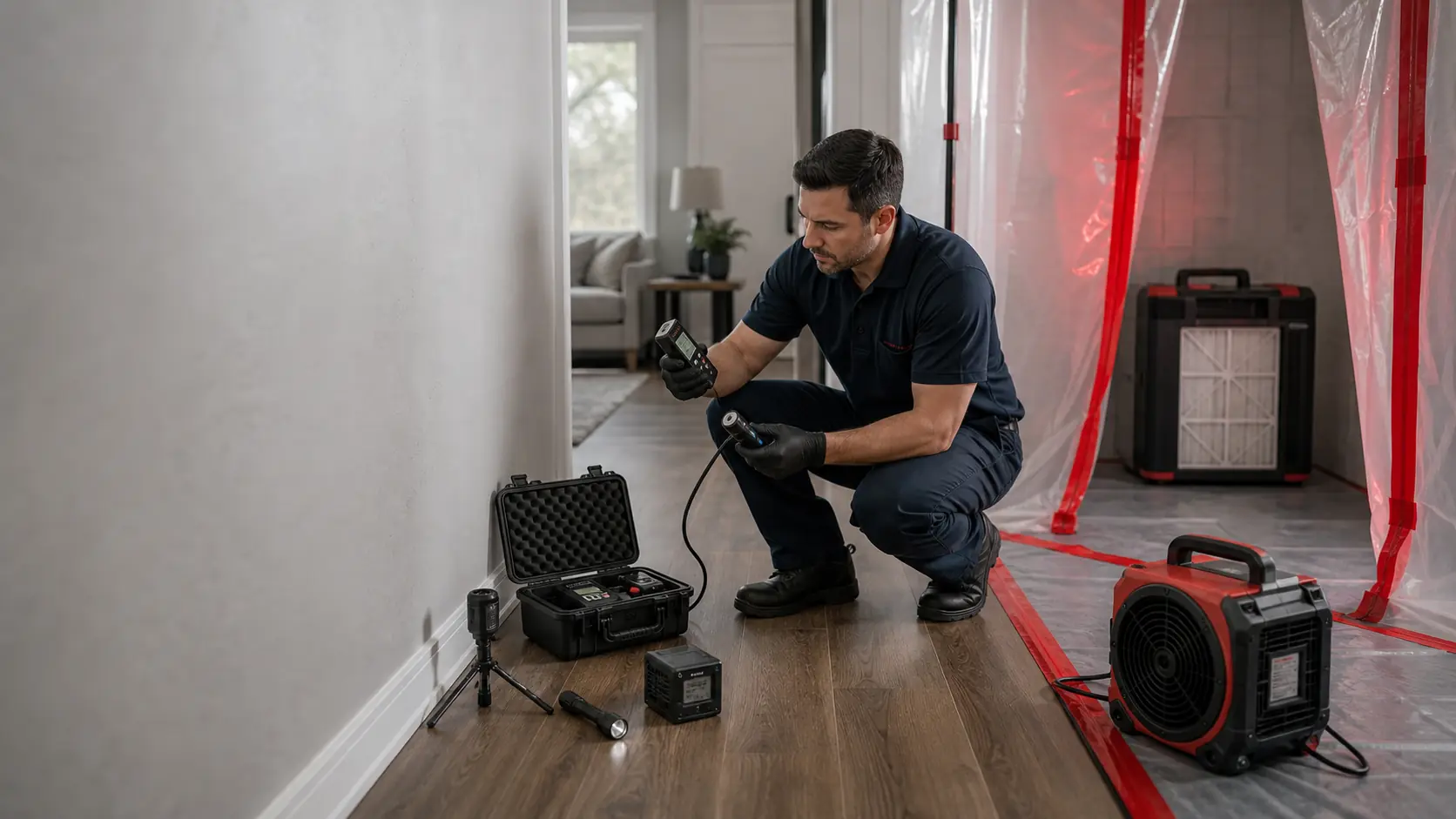
A mold inspection answers the questions do I have a mold problem, where is it, and how bad is it? It involves:
Some inspections also include testing (air or surface samples) to confirm the presence and concentration of mold, though visible mold often doesn't need testing to know it must be removed. Inspection is diagnosis.
- A visual assessment of affected and at-risk areas.
- Moisture detection with meters and thermal imaging to find dampness (including hidden moisture behind walls or under floors).
- Identifying the source of the moisture feeding any growth.
- Determining the scope — how far the mold extends.
Mold remediation: removing and correcting
Remediation is the actual cleanup — safely removing the mold and resolving the conditions that caused it. Done properly (per IICRC protocols by AMRT-certified technicians), it includes:
Remediation is the cure. See our full mold remediation process.
- Containment — sealing off the area so spores don't spread during removal.
- HEPA air filtration to capture airborne spores.
- Safe removal of mold and unsalvageable porous materials.
- Cleaning and sanitizing of surfaces and contents.
- Moisture-source correction — the step that prevents recurrence.
Which do you need?
- See or smell mold? Start with an inspection to confirm the extent and source. (Ours is free.)
- Confirmed mold problem? You need remediation to remove it safely and stop it returning.
- Often it's both, in sequence: inspect to scope it, then remediate.
A note on "mold testing"
Testing has its place — for example, confirming a problem when mold is hidden, or post-remediation clearance to verify the area is clean (see post-remediation mold testing & clearance explained). But you generally don't need a lab test to justify removing mold you can clearly see — that just delays the fix.
The bottom line
Inspection diagnoses; remediation cures; and the moisture fix is what makes the cure stick. A company that only "treats the surface" without inspecting the source or containing the work isn't really doing remediation.